


After a little more than a year in retail, natural energy drink Huxley is unveiling a revamped visual identity to better communicate its positioning as a moderately caffeinated, hydration-focused option in the increasingly competitive category.
“Almost every big beverage brand goes through a redesign,” founder Simon Solis-Cohen told BevNET. “We’re roughly a year-and-a-half old and pulling below 1% of household penetration. It’s better to rip the band-aid off and spend the money now versus wait five years when we’re national and it’s more difficult to reeducate the consumer.”
Standing out is as important as ever in Huxley’s corner of the beverage market. In the 52-week period ended August 10, energy drink sales grew 10.2% to $25 billion, according to Circana data. While legacy players like Red Bull and Monster still hold a lion’s share of the category, better-for-you options saw the largest increase in consumption between 2023 and 2024, per Mintel.
Huxley’s new look changes the front-of-can product description from “superfruit energy drink” to “energy with electrolytes” to highlight its hydration-forward formula. The back of the can features a new tagline, “Refreshingly real energy,” as well as key callouts like 90mg caffeine, 100mg electrolytes and 50mg L-theanine. The redesign was completed in partnership with Bex Brands, the company behind the original Suja and Once Upon a Farm branding.
“[Our rebrand] focuses on the idea of real energy. We use a plant-based energy source (cascara), not synthetic caffeine. ‘Refreshing’ speaks to the flavor and taste from the real fruit juice,” said Solis-Cohen. “It’s not artificial candy flavored; we’re not selling indulgence. We’re selling refreshment.”
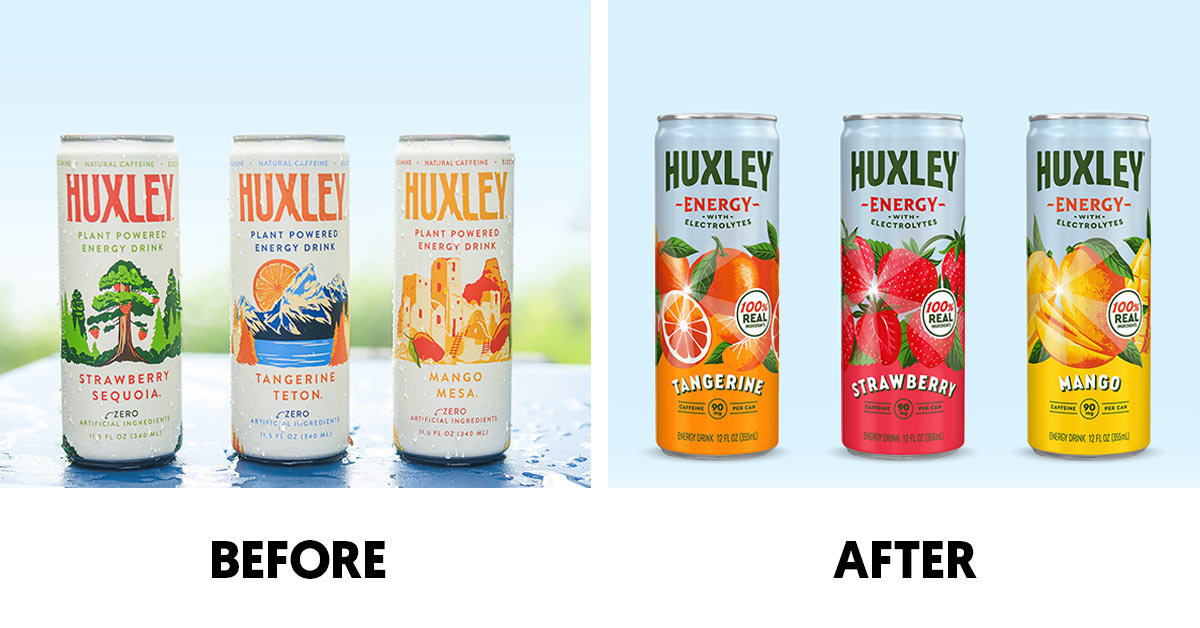
The brand’s previous packaging design centered around bespoke national parks poster-inspired imagery and themed flavor names like Tangerine Teton, Strawberry Sequoia and Mango Mesa. Solis-Cohen, who had previously owned and run a wine marketing company, initially focused on the storytelling aspect often seen in wine labels.
The original cans were the result of a branding exercise focused on meeting the needs of who the brand believed would be its core demographic – outdoor enthusiasts.
“We kind of created this archetype. From there, we thought this idea of the national parks was an interesting way to tie that whole story together and offer a point of differentiation,” said Solis-Cohen. “As a general observation, the [can] designs for a majority of energy drink brands are just their name or logo. There isn’t much storytelling being done.”
Solis-Cohen acknowledged the disconnect between Huxley’s liquid and its first can design: he overcorrected for a problem that didn’t necessarily exist. After months of consumer testing and retailer feedback, he realized the original design didn’t fully highlight the outcome-driven attributes that set Huxley apart.
“We were pigeonholing ourselves into a niche and actually alienating consumers and use cases. I decided that we needed to make [the packaging] simpler – we have electrolytes and we need to shout out that value proposition,” said Solis-Cohen.
He continued, “In marketing, complication is never good. You don’t want to have to explain yourself. I realized that we had such a unique, differentiated product that the packaging could just tell that story.”
Anecdotally, roughly 50% of Huxley’s consumers have never purchased an energy drink due to preconceived notions about the category, according to Solis-Cohen. Huxley’s formulation has always featured better-for-you ingredients and attributes that drive incremental sales, but the previous packaging wasn’t effectively conveying that to consumers or retailers.
Twenty-one percent of the brand’s consumers are aged 35 to 44, while 40% are aged 45 or older. According to Solis-Cohen, the new packaging meets the consumer where they are.
“It’s all about incrementality. We feel that we can bring in a new consumer who doesn’t already shop the category. According to Mintel, 32% of consumers are interested in low caffeine – that’s a third of the market, and no one is speaking to them,” said Solis-Cohen.
Looking ahead to 2026, Huxley’s primary goal is to expand distribution into new territories, including California, Arizona, and Texas. Additionally, the brand is set to launch a fourth core flavor in January.
“We have a lot of commitments from indies and smaller chains. We value retailers of all sizes – they’re all necessary to build a successful plan,” said Solis-Cohen.