

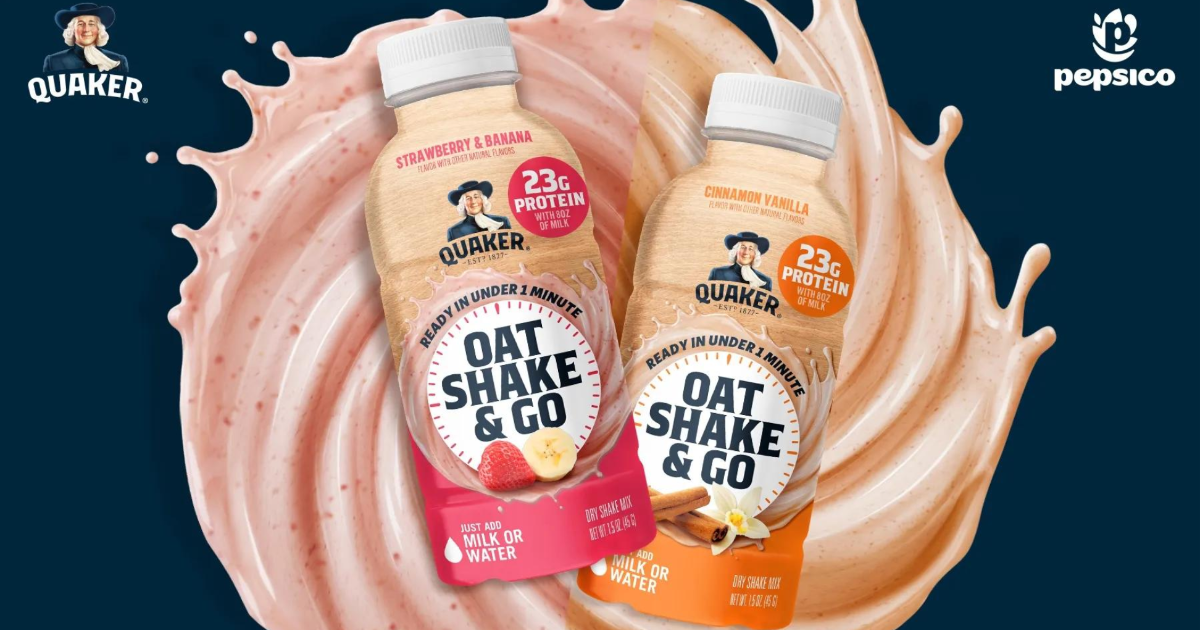
Quaker wants you to drink your oats– again.
The Pepsi-owned brand yesterday announced the launch of Quaker Oat Shake & Go, a shelf-stable, read-to-mix oat shake that contains 16 grams of whole grain oats per serving, along with 15 grams of protein and three grams of fiber. It’s available in two flavors, Strawberry & Banana and Cinnamon Vanilla; to prepare, just add 8 oz. milk, plant milk or water and shake.
In a statement, Pepsi pointed to (where else) social media as the product’s inspiration: according to the brand, searches for cold prep oats have risen nearly 50% on TikTok year-over-year. It’s not being pitched as a meal replacement, but rather as a “convenient, on-the-go snack.”
“For nearly 150 years, Quaker has been a trusted authority on oats and a beloved household brand known for quality and nutritional expertise,” said James Wade, chief marketing officer for Quaker Foods. “The introduction of Quaker Oat Shake & Go helps reimagine the way our nutritious oats show up – bringing the power of protein, fiber and 100% whole grain oats into a delicious, drinkable format.”
If this sounds familiar, you’re not crazy: amidst the oat milk craze of the late 2010s, in 2018 Quaker introduced a refrigerated, three-SKU line called Oat Beverage in 48 oz. multi serve bottles. The line, which was produced by Shamrock Farms in Augusta County, Va., was made using an oat bran concentrate that contained .75 grams of beta-glucan, a soluble fiber in each 8 oz. serving.
Pepsi discontinued that line roughly a year later.
Quaker’s next attempt at beverage innovation arrives as other oat milk leaders are looking to move the category forward as the category’s initial momentum has waned. In February, Oatly announced a slate of innovation including a first-to-market plant-based Cold Foam for coffee. The brand’s Barista oat drink roster will be getting some new flavors as well, with churros and coconut SKUs expected to join existing flavors like popcorn, caramel and vanilla. Elsewhere, HP Hood-owned Planet Oat has leaned into indulgent flavors and licensed partnerships, such as Netflix’s Emily in Paris.
After driving sales through price hikes over the last several years, Pepsi rebounded to volume-driven growth in Q1, thanks in part to price cuts to some of its popular snack brands like Lay’s.