

 A U.S. Surgeon General advisory issued today called for adding cancer risk to health warning labels on alcoholic beverages and called for “a reassessment of the guideline limits for alcohol consumption to account for cancer risk.”
U.S. Surgeon General Dr. Vivek Murthy issued the “Surgeon General’s Advisory on Alcohol and Cancer Risk,” which said there is a “direct link” between consuming alcoholic beverages and increased risk of cancer “for at least seven types of cancer.”
Alcohol consumption is the “third leading preventable cause of cancer” in the U.S., trailing tobacco use and obesity.
Murthy said in the announcement: “Alcohol is a well-established, preventable cause of cancer responsible for about 100,000 cases of cancer and 20,000 cancer deaths annually in the United States – greater than the 13,500 alcohol-associated traffic crash fatalities per year in the U.S. – yet the majority of Americans are unaware of this risk.”
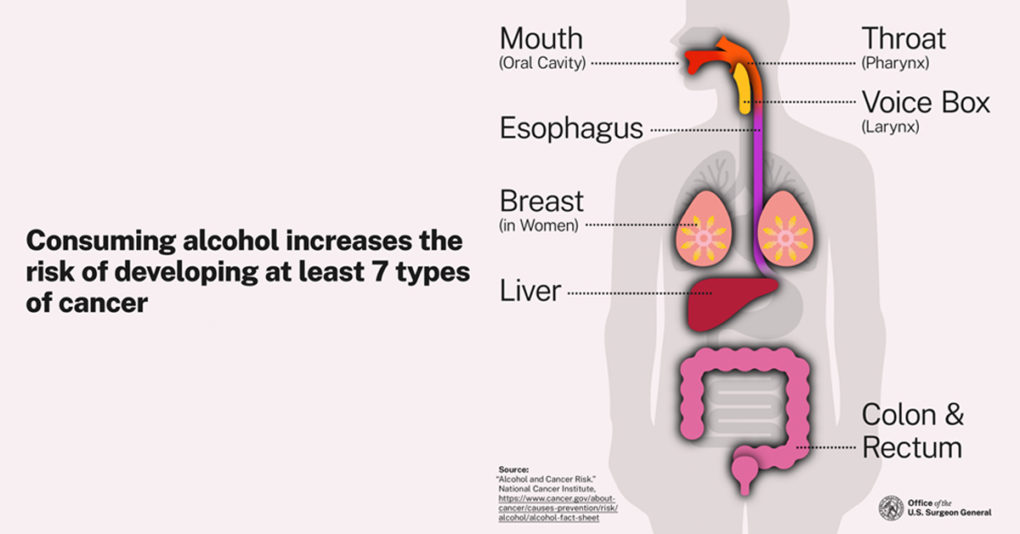
The link between alcohol consumption and cancer risk is “well-established for at least seven types of cancer including cancers of the breast, colorectum, esophagus, liver, mouth (oral cavity), throat (pharynx), and voice box (larynx), regardless of the type of alcohol (e.g., beer, wine, and spirits) that is consumed,” per the advisory.
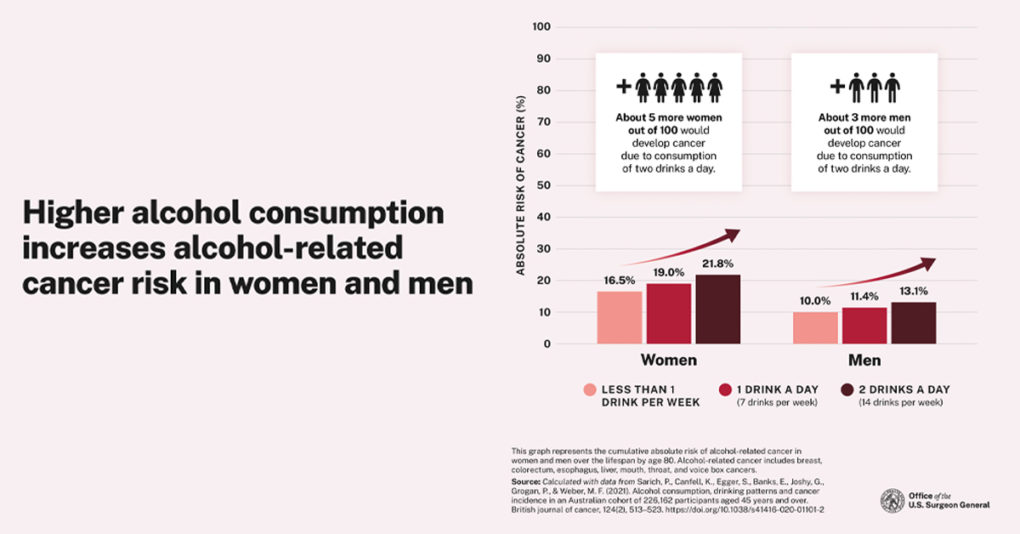
The advisory noted that 16.4% of all breast cancer cases are attributable to alcohol consumption. Additionally, “cancer risk increases as alcohol consumption increases,” and “evidence shows that the risk of developing cancer may start to increase around one or fewer drinks per day.”
Globally, 741,300 cancer cases were attributed to alcohol consumption in 2020, according to the advisory. People who consumed between two and four drinks daily accounted for the plurality of those (28.3%), followed by those who drank six or more servings of alcohol (26%), people who had fewer than two drinks daily (25%) and people who had four to six drinks daily (20.7%).
Murthy noted that “less than half of Americans recognize it as a risk factor for cancer.” He called on public health professionals and community groups to “highlight alcohol consumption as a leading modifiable cancer risk factor and strengthen and expand education efforts to increase general awareness,” and health care providers to “inform patients in clinical settings about this link and promote the use of alcohol screening and treatment referrals as needed.”
Murthy suggested warning labels on bev-alc be “more visible, prominent and effective in increasing awareness about cancer risks. Existing required labeling, enacted in 1988, states that “women should not drink alcoholic beverages during pregnancy because of the risk of birth defects” and “Consumption of alcoholic beverages impairs your ability to drive a car or operate machinery, and may cause health problems.”
The advisory includes shareable graphics delineating alcohol-related cancer risk statistics.
The Surgeon General’s report comes as the 2025 Dietary Guidelines for Americans’ alcohol consumption recommendations are being drafted.
The first of two reports that will inform the guidelines found that moderate drinking is better than not drinking for certain health issues. Although several headlines proclaimed the 230-page National Academies of Sciences, Engineering, and Medicine (NASEM) report a win for the bev-alc industry, the study “concluded with moderate certainty that consuming a moderate amount of alcohol is associated with a higher risk of female breast cancer compared to never consuming alcohol.”
The Interagency Coordinating Committee on the Prevention of Underage Drinking (ICCPUD) report – which has been the focus of opposition from bev-alc trade groups – is expected to be released very soon.
Requests for comment from the Beer Institute, National Beer Wholesalers Association and Brewers Association were not returned as of press time.