Search across the BevNET CPG Media network including BevNET, Nosh, Brewbound, Taste Radio, Nombase and CPG Jobs.

Office Hours: Incubators and the Plague Year: Lessons from Startup Classes During Turmoil
In the past year, an unprecedented set of challenges related to the COVID-19 pandemic has forced new brands to recalibrate many of the business plans they worked so hard to create -- and offered incubators new insight into the kinds of tools brands need to thrive in times of crisis.
This month’s Office Hours assembled leaders from three leading incubation programs to get strategic advice for brands on overcoming the kinds of obstacles they face as they grow, and ways that they can pivot safely when they’re met with unexpected challenges. The takeaway: tough times aren’t always end times, and our conversation with these leaders shows us why. The panelists also explored some of the challenges and opportunities that are specific to minority-owned or minority-led food and beverage startups during the last year.
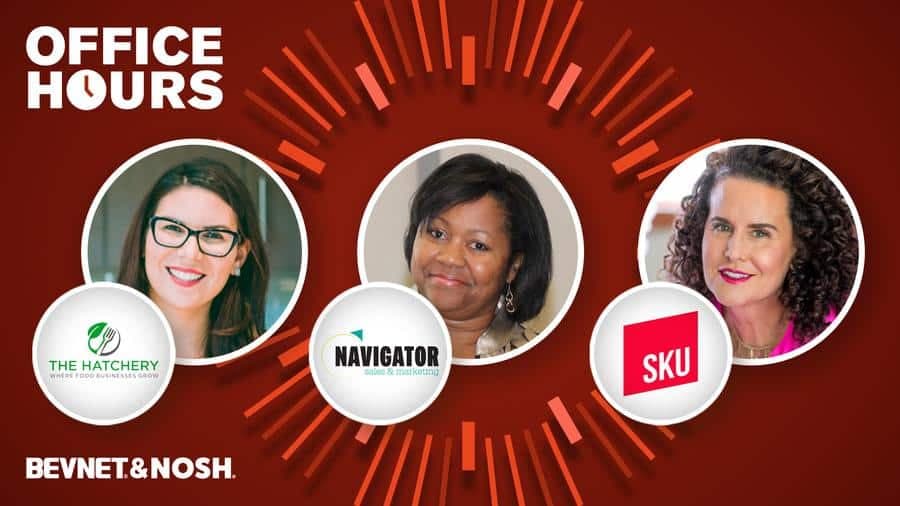
Subriana Pierce, the founder of Navigator Sales and Marketing and the Navigator Foundation, Natalie Schmulick, CEO of The Hatchery, and Michelle Breyer, COO of the SKU Incubator in Austin, Texas all joined BevNET’s Jeff Klineman and a studio audience to share ideas, questions and answers.
Transcript
Note: Transcripts are automatically generated and may contain inaccuracies and spelling errors.
Jeff Kleinman [00:12] Welcome to Office Hours, the show where we bring the networks of Bevneet and Nosh together to provide assistance and answers to entrepreneurs as they fight to grow. I'm Jeff Kleinman, editor in chief of Bevnet. We focus a lot on startups, but today we're going to dig a little deeper into the realm of those incredibly valuable startup support organizations known as incubators. Pulling together groups of promising founders into cohorts, incubators offer experienced guidance, financial, tactical, and importantly, emotional support, and a kind of skilled safety net to help lend brands the strength they need during critical early learning stages of their development. As we know, the pandemic has forced a lot of changes for startups, pushing some to the back of the line for financing and operational capacity, opening opportunity for others if they fit a need and could be sent online. We also know that time and pressure force change, and the pandemic has created a new kind of pressure for startups under what seems like an endless amount of time. By checking in with incubators, we're going to be able to get a bigger sample of these startups under pressure and the way they're reacting to that pressure in a shorter period of time. So we brought together 3 executives who have direct experience working with these incubated cohorts throughout the pandemic to explore the ways that that this time has either created new challenges for entrepreneurs or exacerbated the kinds of challenges that they tend to face organically. Because the one thing about incubators is that their leaders tend to get asked for advice a lot of the time. And in hearing what kind of advice these folks are getting asked for and what the cohorts are doing and what's working when they do it, we'll hopefully be able to extract guidance that can help both startups and established businesses move forward through this period. So I'm so thrilled to have with me today Sabrina Pierce, the founder of Navigator Sales and Marketing, and the Navigator Foundation out of Southern California, Natalie Schmuli, the CEO of the Hatchery in Chicago. And Michelle Breyer, the chief operating officer of the SKU incubator in Austin, Texas, and a few other cities. Michelle, Natalie, Sabrina, thank you so much for joining me. I'm hoping that to start off you can each describe your organizations and the way they work with entrepreneurial food and beverage brands, what their size and positioning are, and what kind of programming and advisory services you give them. I'd love to start with Sabrina.
Speaker 2 [03:40] Sure, uh, I'm, uh, excited to be here. Thanks for having me today. So I own Navigator Sales and Marketing, which is a broker, uh, food and beverage broker, and we've been in business for about 8 years and we've always focused on emerging brands or had a good, uh, client base of emerging brands. But in February, we launched our first, uh, I guess, yeah, educational webinar series through our foundation. Uh, one of the things that happened for us as a, a black-owned broker, we looked at our own portfolio and through the civil unrest of last year, we realized we weren't representative enough in our own client base, and that's when we started a 5001c3 organization to support, um, to support that. It was what could we do and that's what we decided to do. So we have about 25 or so brands that are part of the foundation. Um, and we focus on getting them ready to sell. That's what we know. That's what we do on the brokerage side, and it's, um, training and development on getting them ready to get in grocery stores.
Jeff Kleinman [04:50] Michelle, uh, can you tell us a little bit about SKU?
Speaker 3 [04:54] Uh, SKU, again, thank you for having me. Um, SKU is, uh, celebrating its 10th anniversary this year. We, uh, we started because Austin was kind of known for its tech industry, and its live music, and it's barbecue, but it had this emerging consumer product industry, but nothing to support it. So, A group of entrepreneurs including Clayton Christopher from uh Deep Eddy Vodka, uh, Sweet Leaf Tea, um, Sherry Wynn Ressler, and Scott Jensen, who was the founder of Step's Barbecue and uh Rhythm Superfoods, got together and decided to create the support that they felt would be ideal for emerging brands, which included a curriculum that was very focused on CPG. as well as mentoring, and, uh, the mentoring is kind of the secret sauce. Uh, each founder is surrounded by a team of team of mentors who are kind of specially selected from them and they're kind of some of the leaders in the CBG industry. Um, we typically look for brands between 100,000 and a million, that's kind of our sweet spot. Um, we have 4 locations now. Uh, we are Austin. Location we are in our 9th track. We have Beyond SKU, which is in New York, and then uh Impact SKU, which is kicking off in June, which is for purpose driven companies, and then we have uh the SKU DFW and uh we just launched the MO initiative which is for BIPOC uh CPG founders. So technically we have 55 programs going now.
Jeff Kleinman [06:41] So super busy, yeah,
Speaker 3 [06:43] very busy.
Jeff Kleinman [06:44] And Natalie, tell us about the hatchery. Is it just Chicago land?
Speaker 4 [06:49] It is, it is, and thank you for having me. I'm excited to join my fellow panelists here. So the Hatchery Chicago is a nonprofit food and beverage incubator. We are based strictly in Chicago, but we do support other incubators around the country and the world. We were formed through a joint venture with two partners. So we have Industrial Council of Nearwest Chicago, which is One of the oldest and largest business incubators in the country and Allies for Community Business, which previously is known as Axion, a nonprofit microlender, and our goal was really to support the West Side of Chicago, which has traditionally been an underinvested area. It's got a thriving entrepreneurial community but never had access to resources and commercial grade kitchen space, so. A few years ago we built a 67,000 square foot facility in East Garfield Park right at Lake and Kedzie where we house a shared kitchen space and 54 private food grade production spaces as well as a full curriculum. Through that we offer 34 hours of free shared kitchen use time per week to local community residents on the West Side and free membership. We have a full curriculum. We have a Sprout program, which is a 6 month program for those who are just starting their business, and then we have a blue membership for those who are a little bit further along. And then we provide all the wraparound support through our joint venture and through the hatchery directly where we try to find additional ways to just bring the community together. And Jeff, I like the way you said it about having that emotional. Support, so we really see ourselves as having a holistic approach where we're not just providing technical tools, but we're really trying to boost the community and provide that additional that additional support where we know entrepreneurs are struggling and, and need that extra guidance and so just having a like-minded entrepreneur along your side can go a very long way. So yeah.
Jeff Kleinman [08:39] I, I just wanna start off by asking, how are your cohorts doing? I, I mean, I know it's sort of a broad way to start, but has this been a tougher time than usual, or is it just equally tough, uh, to the experience of the startup?
Speaker 3 [09:02] Uh, for us it's, it's really not, uh, there are added challenges for some of the companies, especially when it comes to supply chain. Maybe some of them, their main business was food service or restaurants. It's really forced some of them to look at other channels that they might not have in the past. Some of them who weren't really looking at eCom as a major part of their business have pivoted. And in the process, I actually think some of them are doing better than they expected, um, you know, again, I, I liked what Natalie said about that support and mentorship because I feel like that was so essential during this time, you know, to have the mentors there who, who really could provide, you know, incredible support and experience that they've been through. You know, I, I would say our current cohort, which is our Track 9, is doing really well, uh, you know, the companies, and one of them in particular, uh, is about 300% above, um, their sales projections. So, um, you know, I, I think that people have learned maybe how to be more nimble and, uh, scrappy, and that's not necessarily a bad thing.
Jeff Kleinman [10:19] What, for those brands that have been successful, uh, what are the things that they've done? that have enabled them to sort of take advantage of the situation.
Speaker 2 [10:31] Well, I'll, I'll start. I think, um, I, I think e-commerce was, was really helpful. I think it was always, uh, many of our brands strategies, but they had to step it up last year and into this year, and I think they've seen better results than they probably imagined. Um, I think what I've seen some brands do a great job of is play up more priority benefits. So let's say. Immunity was one of your brand benefits. Well, that went to the top, right? That was like your key primary benefit when you're selling into a retailer because people were thinking about immunity and safety and, and all of that. And so, I've seen, uh, you know, different priority shifts like that that have made, you know, some of the brands more successful.
Speaker 4 [11:20] I'd say with the brands that we work with, those that started to explore less traditional retail channels, we knew that gyms, beauty salons were all struggling when they had to close down, but now they've opened up as an opportunity to be a multi-use space. So we've seen a lot of entrepreneurs explore those channels right now, as well as restaurants that have converted their space. To be a combination of restaurant, ghost kitchen, and market. So that's been a really successful approach and then just brands humanizing themselves. So really finding this opportunity to connect with their consumers and pull back the curtain to say we're going through this too, and let's tell you more about who we are as founders and who we are as a brand.
Jeff Kleinman [12:03] I understand that that pushing into ECO or sort of emphasizing something on a temporary basis like immunity can be really good for a startup. Is there a concern that you can get too wedded? To one successful strategy, um, for a short period of time, knowing that in the long term, change may, uh, cause you to have to go back. That, you know, certainly we hear with ECO. It's great right now. It creates signal. It's the, you know, for some brands, it's the only way to get into consumers' hands. Is there a concern that they become too wedded to this?
Speaker 3 [13:02] I think because um so many of the brands had to learn how to do things quickly during the whole COVID experience, that they know how to, how to How to pivot quickly now, um, and I think also uh to your point about um ECO and immunity and and some of the health benefits maybe being short term. I, I really don't think they're gonna be short term. I think that um these are gonna be things that kind of stick the consumer. Their habits have changed and their priorities have changed, so, um, you know, better for you products. I don't think those are going away and I think, you know, that kind of emphasis on the health benefits of a product. Um, are, are gonna be with us kind of going forward and I, and I think for a lot of the companies that started doing ECO it became a, you know, like they were really surprised at their margins, you know, it in a way it became a much more profitable channel. So while they may go back to some of the other things that they were doing, I don't think they're gonna, you know, abandon ECO or some of the, the new things that they discovered as a result of COVID.
Speaker 2 [14:15] Yeah, I would agree with that. I think it's a hybrid approach that we're going to see, and I think for some of these brands, it's how do you diversify your multiple streams of income. So you're not going to lean in one, you're going to figure out a way to, to, to have those multiple streams, and e-commerce is one, and you know, just like brands that maybe were only in. Uh food service only in restaurants. Well, they had to pivot and figure something out. Ones that were in grocery stores had other issues to deal with last year and they had to figure something out. So I was looking at the St. Albertson's, you know, just released their ECOM numbers the other day, and I think Q4, they were up 282% and Q1, I think already up 200%. That's not going away. It might not be up 200%, but that growth is there. And so the brands that can figure out the multiple ways of distribution will be the ones that win.
Jeff Kleinman [15:13] What's the key to being able to pivot? What have you seen from those brands that are able to do so in the past year?
Speaker 3 [15:22] I, I think it's a You know, willingness, uh, it's, it's a mindset. Um, if you do not have that ability to do that, you're gonna, you're gonna suffer. And so I think entrepreneurs just in general, uh, you need to be flexible. Um, having been an entrepreneur myself, I remember you may be like really stuck, this is your strategy, but. If things change, you know, yeah, I think you have to have that mindset, and I think that's where having, uh, that mentor community that we do around our, our, um, our founders is so helpful because they can kind of help them think in a different way, you know, maybe you've got this is your only strategy. Well, maybe you should explore these other, other ways of doing things, and then it's like a muscle that you less. The more that you kind of learn how to. You know, shift your, your strategies, I think the easier it becomes.
Speaker 4 [16:20] I agree with Michelle. I would say the entrepreneur mindset is not being risk averse, and that's very key is that if you are going to be flexible and be able to pivot, you have to be comfortable with knowing that pivot might not be successful, and we did see a lot of that, but just being candid and open and OK with that and realizing it's a learning opportunity, we saw. A lot of catering businesses pivot to meal delivery almost immediately, and that's not an easy pivot. So I think testing it out and seeing if that's something that your customers are receptive to and being OK with realizing maybe this isn't the right approach. Let's try something else that's going to create an environment where you are continually flexible and able to pivot. Um,
Jeff Kleinman [17:03] what are some of the key pieces of advice that, that your mentors, uh, keep getting asked for and that you get, keep getting asked for?
Speaker 3 [17:17] There's so many. I mean, I feel like it's everything from, you know, obviously there were issues in some cases with cash flow. That was a huge one, and I think that that continues to be a question, you
Jeff Kleinman [17:33] know. Were there temporary cash flow solutions during this period that haven't been deployed in the past?
Speaker 3 [17:42] PPP loans for for a lot of our companies and and that became a big area where our mentors really helped our our uh founders kind of navigate that whole process of how to apply for PPP loans but I, I would say that was kind of a lifesaver for some of the companies in our in our cohort. And ours.
Speaker 4 [18:04] For us it was discovering new opportunities as well as a nonprofit incubator. So one of the biggest challenges we saw were those with catering businesses. Most of the entrepreneurs we serve on the west side are catering businesses, and their revenue went to zero overnight, and there wasn't a lot of support early on for caterers. There was a lot of focus on restaurants and of course many CPG brands were actually doing better than ever, so we saw. Opportunity to start building a new program and finding ways to provide funding to these catering businesses. So we actually developed a program called Hatch Made Meals where we would pay the catering businesses to produce meals which would be donated to local community organizations supporting individuals facing food insecurities. And when we started the idea, we did not know if anybody would be interested in funding it, and one of our partners funded it for a year. And so now we were able to provide. Funding to over 12 caterers who each produce uh within a cohort 500 meals a week which are donated to community organizations. So finding those creative ways to access funding like that. And in addition to Michelle, we, we through allies we were able to provide coaching and counseling on how to navigate some of the grants and loans that were available because they weren't easy to navigate. And so I think providing that type of support and information was essential.
Jeff Kleinman [19:29] Now you all run classes. I, I'm wondering, you know, are, are there some, some topics that are being, say, better attended than they have been in the past?
Speaker 3 [19:44] All our, our founders have to go to all the classes, so they're, they're not optional, but the ECO class, um, I, I think that that we made that more of an emphasis. We made sure that we had, um, more mentors that had that background and that we focused on it a little bit more because that definitely was, you know, ECO, uh, you know, whether it was B2C or Amazon that became, you know, kind of top of mind for so many of our founders.
Speaker 2 [20:14] Yeah, that was an area we focused on and again, we just started our webinars in um in February, uh, our training, but for the existing brands that were, that were new to the grocery industry. So here you are on the shelf and all of a sudden demos are gone. Um, all of a sudden you couldn't really display like you wanted to. Um, e-commerce got bigger. When people did go into grocery stores, they're not necessarily looking for innovation. I want the item I always get so I can get out of here. Um, so it was very, it was very tough for those brands. And so I have found that e-commerce was Uh, a big one for us. And you know, we, we started out as a foundation around brick and mortar, but we had to pivot to make sure that our brands got what they needed. And so we did a big focus on digital marketing as well as e-commerce that seemed to get a lot of, uh, a lot of support and a lot of uh attendance.
Speaker 4 [21:14] We actually had, interestingly enough, one of our most attended classes during the pandemic was our starting a food business class. We thought there would be a drop, and when we were asked by a lot of press and big CPG brands if there was a drop because they assumed people did not want to get into the food and beverage industry, seeing all of the difficulties these businesses were facing. And on average we see 30 to 50 attendees every month and in January we saw over 70. So that was really interesting and, and very telling of interest from consumers who now want to launch brands because there's a lot of new opportunities.
Jeff Kleinman [21:53] Is that also, do you think, a factor of people looking for new opportunities to work?
Speaker 4 [22:01] I think so. I was reading an article recently about the number of people who quit their jobs because they wanted something that was a little bit more fulfilling that met their passion. So I can imagine for a lot of people it really presented an opportunity to really follow a dream that they had many years ago, and this, this was the time. So I do, I do believe that's one of the approaches is just finding another opportunity outside of their usual work.
Jeff Kleinman [22:30] We talked a little bit about your evolution as an organization, Sabrina, and I, I want to get back to that. In a minute, but I also want to make sure we talk about The fact that, you know, for Uh Minority communities. All of which you work with. Um, there have been disproportional infection rates, fatalities, economic consequences, unemployment during the pandemic, um, and we've seen enormous social upheaval and consciousness changing with regard to minority-owned or minority-run incubation cohorts. Are there ways they're being affected differently? Then a Than other groups of startups.
Speaker 2 [23:41] Yeah, I think so. I think um. I was just looking up some facts around both women and minority. Uh, it's a vicious cycle, and there's no way that you can't say what's happening in the world doesn't affect what you're doing with your own company and how you're coming, going to market. But I, we were looking at the, the December job loss, just as one example. I think it was 140,000 jobs lost, 100% of them were women. Right? And so when you have these companies that are bootstrapped, and now they have the most uh uh job loss, it's, it's a cycle. I was looking at the April, so last year at the height of COVID, um, unemployment rates, I think for whites were 13%, for blacks, 16.4%, for Latinos, it was 19%. So again, it affects what they can do when they want to start a business and then I, I saw, you know, just horrible information about 41% of black owned businesses that went under during COVID. Now this was broader than, you know, consumer packaged goods, but 41%. So these brands that are bootstrapping themselves, um, it makes it hard. And then when you add on venture capital funds, I think less than 3% are going to women and less than maybe 2.5% going to people of color. Women of color, I think it's like 0.007% or something. So all of that affects, um, you know, how do you show up on shelves and then how can you sit beside a brand that had funding and had that, um, didn't have all of those um. Things surrounding it and how they got to the market, so it makes it very tough, I think, for brands.
Speaker 3 [25:35] We, um, definitely with, with this track that we're running with Naturally Austin, we have 77 founders going through it and there's kind of some common themes, um, things that. People, uh, you know, white entrepreneurs might not have to deal with, um, in terms of just like lack of a network in the CPG community, you know, lack that access to capital that they don't necessarily have connections to, um, you know, the, the mentoring, uh, that just. You know, helps you move from Here to here. And um you know, we, we definitely that we're trying to bridge that gap through education through mentorship, uh through the networking because all those things are things which, which can hold a in a BIPOC founder back and that's what we're hearing from them, you know, that that's really what they need. They just wanna level the the playing field.
Speaker 4 [26:35] I was just going to say on that topic of mentorship, I think that's really key is you want to see someone who looks like you who's done it, who's been successful, and that's something that we are also trying to work on is a lot of times if you see panels, if you see education sessions, you're looking at people who just don't represent you, and I think that representation is so important. I think what is good is that there was this grand awakening and people realized we need diversity in people and products and concepts and so from a consumer standpoint, a lot of the brands that we work with have had the opportunity now to step in. We've had AO Foods, a West African cuisine, Kororin, this Onigiri shuttle, Coco Chili Foods, Chin Chin, this. African snacks, they've been given this new platform, and I have to give them so much credit because they've really stood their ground and started to promote their brands in a way that they just didn't feel comfortable before. And now that people are demanding this opportunity, I think we're seeing that change start to happen, but there's so much more, and particularly with funding. That's one of the biggest challenges, and that just has to continue.
Jeff Kleinman [27:44] Are there ways that you're able to keep these brands in the game? Uh, that are sort of required when that support hasn't been there in the past.
Speaker 2 [28:03] Well, I think a lot of it is education and understanding um maybe where they can get support. Um, I, I, I do resources for all of our brands where I, you know, I might send them to another um incubator that says, hey, this topic is perfect for what you're going through. You know, it's how do we all work together to provide these brands as much information as we can, but I've never seen more. Grants and pitch competitions than ever in my entire career than probably in the last, you know, 9 to 10 months. So, you know, we're telling our brands to jump in, be strategic about it because you could, you could spend You know, a lot of hours to get $1000 on a pitch, you know, or, you know, just be strategic about it, but it's out there. We just have to make sure they're getting the information.
Speaker 3 [29:02] One of the things that's been so encouraging to me is how many of the brands we work with the larger brands like the General Mills and the PepsiCo and and Amplify Snack brands, like they want to, you know, provide funding. They, they're looking for ways to provide funding now for BIPAC founders, you know, it, it's a priority for them. And we're seeing more funds that that are focused on that. And in fact, Tito's Vodka has a million dollar fund that's all to help um not just CPG founders but uh BIPOC artists and musicians and just, you know, there's a, a hunger. To help in whatever way possible, I think right now, and hopefully that's not just right now. Hopefully that'll continue, you know, into the future and won't just be because of where we're at in the world right now.
Jeff Kleinman [29:54] But there has to be an urgency. Uh, both on your part and the part of the brands to say you don't know. When that window of consciousness closes.
Speaker 2 [30:11] It's scary for our, our brands, I can tell you, um, a lot of them think that it is, um, gonna leave, that this isn't going to continue, and I pray and I hope that it does continue because it's the right thing to do. Um, but it, it, it makes you act now. It, it gives you an immediacy about driving your business because the door might be open right now and everybody's scared the door won't be open next year.
Speaker 3 [30:44] Well, and hopefully it will have a ripple effect where those successes will lead to more successes. So the fuel on the fire right now might, you know, continue on and and interesting in different ways just because you're going to hopefully see more success stories. Right.
Jeff Kleinman [31:02] Are you concerned that brands may get in over their heads because of the urgency to take advantage of movements toward supplier diversification, um, Brands that are trying to make themselves look better as opposed to genuinely bring, uh, BIPAC owned brands into the community.
Speaker 2 [31:36] I think what we're trying to do is a little bit of the behind the scenes math with them to say, OK, this sounds good, but are you ready for 8000 stores? And so have them understand the math behind that because growing too big can put you out of business faster than growing, not growing at all. So, um. You know, so they, I, but I think everybody wants to get in. One of the things that I'm seeing from the retailer side, especially the larger ones, are the test markets. You know, I won't give you the 8000 stores, let's try in 100 stores. 100 stores for some of these brands is huge, right? And so then you start to get that traction and so, um, yeah, so I think there's an eagerness and I think there will be some brands that probably will get in over their head, but Um, I know we're trying to at least provide that math so that they know, you know, the right direction to go into.
Speaker 3 [32:33] That's the importance of, of these types of incubators, I think, too, because, you know. It might set them up better for success, uh, as these opportunities are, are being made available to help them, as, as you point out, you know, like, If you get a 1000 store deal and it's not the right deal, you have these mentors to surround you and say, hey, you may want to think about it this way, or, or, you know, I know this sounds good, but let's slow down a little bit, and I, I think that's where all of, all of your organizations and our organization, you know, we can really make a difference that way.
Speaker 4 [33:15] Yeah, to Sabrina and Michelle's point, I think it is our job as incubators to provide that guidance, and one of the benefits in our kitchen is we're not looking for people to come in and pay rent. We actually look at their financials. We look at their P&Ls and all of their planning, and if they can't afford to be in the kitchen, we have to sit them down and talk through it because the last thing we want is for them to accumulate debt. So it's really Really important for us to go through the full landscape and and get a good understanding. I think one of the industries right now that can be challenging, that has opened many doors but also provided new challenges for entrepreneurs who feel this is a great opportunity but can get in over their head is really the cannabis space, and I think there has been this focus on trying to promote. Promote more diversity, but the funds that are required to actually successfully launch a cannabis brand are astronomical. And so that's one of the spaces that we need more resources. I think Presco is starting to do a really good job of providing that information, but that is an industry where we have seen a lot of entrepreneurs get very excited, but then as they get started, they're overwhelmed.
Jeff Kleinman [34:25] I wanted to see, are your cohort brands, we talked a little bit about employment. In the past, I want to see, are your cohort brands getting to the point where they're starting to add people? Have they lost? People, have they had to move their human capital around?
Speaker 4 [34:47] Yeah, we've actually seen both so we've seen and I would say last year looks very different than this year so you know the challenges that were really pivotal at that time have now. Kind of converted to opportunity, but we did see a lot of brands lose team members and then bring them back on. I think the biggest change is the focus on priority. So what is the help that you actually need that you will most benefit from as a founder, and that's where the focus is going. And realizing that it doesn't necessarily have to be a full-time team member, you can contract the work out and in some ways that's better for a lot of new founders because really building out a team and especially full-time team members can be extremely daunting. We have a workforce development team that works with the entrepreneurs to better understand their needs because oftentimes when they're hiring for the first time they don't know what they need, they don't understand the process, they don't understand the market rates and the management of it all. So it is really important to be strategic about how you're building a team, but I think we've seen that shift now towards really starting to bring more team members on and to be more strategic about it.
Speaker 3 [35:59] I, I totally agree with Natalie. Um, although we have a lot of solo entrepreneurs that go through SKU, um, and that first hire is like so key, and last year that wasn't even something that they could consider or a lot of them couldn't, and now, um, a lot of them are, you know, looking at sales help. They're looking at marketing help, um, you know, I agree in a lot of cases we need to kind of. Point them toward uh contract work because that's much easier to manage if your sales go, you know, go up or down, but, but we definitely are seeing movement. We're getting a lot of, a lot of, uh, founders and alumni coming to, you know, and mentors coming to us saying, you know, do you know anyone who's, who's a good salesperson, you know, we're, we're hiring for marketing, we're hiring for social media, so I think that's really exciting.
Jeff Kleinman [36:51] I wonder, you know, as you see brands move toward D2C, as you see them conserve capital and develop Plan B's, um, Are they? Hiring to think about a return to normal, and what's your advice to them over the next 6 months, 9 months with regard to that shift. To more conventional times.
Speaker 2 [37:25] I've seen a lot of hires that are probably more outsourced when it just say when it comes to e-commerce and social media even so that employee, they're not necessarily a W-2 employee, but they're outsourcing that which helps them to be able to, um, you know, maybe that role becomes a smaller role or fewer hours down the line when they're shifting either back to food service or shifting, you know, to brick and mortar. Um, so yeah, I, I don't see them where they're spending a lot of time in, you know, one area and that they're going to go too far in that area. I think, you know, as we mentioned before, Having a diversified strategy for multiple streams of income and setting yourselves up for that, and looking beyond 1 year out, looking 3 to 5 years out, you can develop a better game plan.
Speaker 3 [38:20] I still think normal is changing though, like getting back to normal. There is no getting back to to totally normal. I, I, I agree with Sabrina that our new normal may be Having, you know, ECO isn't going away. You'll have retail, you'll have ECO, you'll have food service, but you'll be able to kind of uh pull the levers based on what's happening.
Speaker 4 [38:47] Definitely a new normal. I agree with that and I I think the way we're seeing that in hiring is a new definition of roles which is really exciting so you're seeing a focus more right now on team. A lot of focus on that diversity within team and support within team and team culture. We're seeing that around new initiatives, sustainability is a big focus for big CPG and startups. So there's all these new roles starting to form, which is exciting and it's indicative of the fact that we are likely not going to revert to where we were, but we're just moving forward and seeing new consumer demands that just won't go away.
Jeff Kleinman [39:24] What's the, what's the talent or skill that's most in demand? Is it, is it simply Ecom uh capability or?
Speaker 3 [39:34] That and marketing That's what our founders, you know, and that can mean a lot of different things, obviously, um, but that's a,
Jeff Kleinman [39:45] that's a shift, right, because for a long time your first hire would be in sales. And it's that combination of Uh, ecom is the sales channel is almost a marketing channel. That's probably making that change, right?
Speaker 3 [40:08] Yeah, they're kind of blurring. There's a blurring of lines between, um, you know, sales and marketing.
Jeff Kleinman [40:15] Um, I want to see how you're each adjusting your programming, your planning, um, and, and also get your sense of what the future means for incubation programs and how they can best serve their cohorts in the, in now and in the years to come.
Speaker 4 [40:40] For us, we, we struggled as much as the entrepreneurs did in the beginning, and With our physical space we had to take a good look at what the capabilities are because there are physical limitations when you have businesses starting to shift towards pickup and meal delivery, so we actually had to convert our physical space to allow for more flexibility, which is a good thing that's what we intended. We intended to constantly evolve as an incubator. All of our programming used to be in person. It's now entirely virtual, which has actually provided more access, which is great. I think there were individuals who maybe couldn't get out to our space or the timing didn't work. So we have on-demand programming right now, live virtual programming. And one thing that we launched during the pandemic was we launched a kitchen incubator collective where we wanted to learn from other incubators, and I think just being with these amazing panelists, you learn so much from one another. And so every month now we get on this Zoom call with up to 20 other incubators in other cities and learning what's going on with them, what are some of their strategies. We all just started sharing our org charts to see how we. We have the right talent within our own organization and what's worked well for them, and I would say that's the future. I think the connectivity is going to continue and it's going to be essential because as our brands expand out of Chicago, we want to be able to provide them with that support in Texas and California and New York, wherever it might be. So we wanna make sure we continue that connectivity and that will be an important piece of of our work going forward.
Jeff Kleinman [42:16] So your incubators are in an incubator.
Speaker 4 [42:20] Yeah,
Speaker 3 [42:22] I, I totally agree with that, um, you know, that pivot that we had to make. I, I remember it was like terrifying overnight. It's like, oh my God, what are we going to do? We're in the middle of a track, and, you know, an in-person, 100% in-person track, and now, You know we can't do that and so we pivoted to Zoom. Zoom is never gonna go away for us now. Like we're gonna be a hybrid program, I think, uh, you know, forever because it has offered so, so many opportunities just in terms of access to companies that can go through access to speakers, access to mentors, um, and we've realized that, you know, Zoom isn't. Exactly like being in person, but there's a lot of benefits to it. But we also still see the benefit of in person. So, uh, having some kind of hybrid program, I think is kind of the ideal, but I don't know whether we would have thought of that had it not been for, uh, COVID, you know, I don't know if we would have gotten there as quickly.
Speaker 2 [43:22] Yeah, I'm probably in the opposite where I started, you know, virtually, and now I'm already thinking about, you know, how to integrate in, in person down the line. Um, but, you know, we, we've, we've shifted a little bit, as I mentioned before, where we were uh almost 100% focused on how do you get on the shelves of grocery stores and how can I help you do that to, like I mentioned before, one of our biggest, uh, Uh, workshops was around e-commerce. We realized that we needed to be a little bit more for our brands than we probably, uh, started out being. Um, we've got, uh, one coming up, like I, I looked at, I, uh, surveyed our our cohort, and 90% said their issue was capital. And we know all the reasons why their issues are capital and so now we're putting some workshops and programs together around that. So, um, you know, we're just listening and trying to provide back what, what, uh, our members are looking for.
Jeff Kleinman [44:31] I wanted to ask one more quick question. When you deal with Groups like you all do, often the groups themselves, someone within the group is able to provide a key insight that sort of goes through the group and says, oh, we've got to try this or don't try that. And I wonder if there's something. That you've heard folks repeating to each other that's been either particularly effective or particularly disastrous uh for your groups during this time.
Speaker 4 [45:14] That's such an interesting point. I'm trying to, I think we're all trying to think of what that might be. I do know one of the best aspects to your point, Jeff, is that connectivity with the entrepreneurs. That's something that happened on its own that we're so grateful is there because there's nothing like hearing it from an entrepreneur who's been there, who's done that. And that is so effective is to hear from someone. I worked with this broker. I had an incredible experience or I did not have a good experience and here's why that's better than any recommendation we can ever give because they experienced it directly. The only thing that is happening now, and I actually just wrote about this for Food Entrepreneur magazine, is mentorship. So how do you approach advisors and how do you pitch to potential investors, and I would say there's good and there's bad advice going around. So that's something that we've been focusing on is how do we just get the right message out there to the entrepreneurs, but I wouldn't say there's anything too bad. I, I think it's all helpful. I mean, experience is learning, so everything that I've heard for the most part is, is beneficial.
Speaker 3 [46:24] The, the key piece of advice we have that hasn't changed, whether it's pre-COVID or, or post, I, I guess we're not quite post COVID yet, but um know your numbers. And uh you know that was important when you were, you know, in the midst of trying to get a PPP loan. It's important when you're raising money, it's important when you're talking to a retailer. I mean, knowing your numbers, uh, you know, for a founder, it may seem, it may seem kind of basic, but it's so important and sometimes it can be kind of. Not something that's a that's a focus.
Speaker 2 [47:07] Yeah, I think for our brands right now they're um because we're specifically women and minority owned brands and there's so many events, uh, whether it's the supplier diversity program here or, uh, you know, all these retailers or ECRM is putting things together. So I think the most beneficial has been them learning from each other on, um, you know, what the expectations are of the different retailers. I think that's, that's helpful.
Jeff Kleinman [47:37] We're going to turn to a couple of quick audience questions. Uh, our first one's from Ziad.
Speaker 5 [47:44] Thanks, uh, Jeff, and, and thank you all for really great insights and, uh, it, you know, it was, um, great to hear the, the points that you brought up. Uh, the, the question that I have is, is around innovation and, um, how essential Is innovation, product innovation around uh to get that initial success, or is it better to find a couple SKUs or one, that one SKU that really takes off in order to, to get a brand to the next level?
Speaker 3 [48:19] Uh, we always talk about don't just innovate, innovate, um, you know, focus on those key brand key skews that you have. Um, we see some companies that just keep on adding products, and that can be a huge mistake, you know, if there's not really a need for them, you know, so getting those products right that you have and having some kind of holy grail products. It is much more important than having like a whole slew of products that may not even serve a need in the marketplace.
Speaker 4 [48:53] Yeah, we see that as well, where innovation doesn't have to be reinventing the product. It can be just improving and listening to your customers. So if it's something as as simple as reducing sugar by a certain number or trying to find a more sustainable sourcing practice, whatever that might be, we see that very integral to innovation. We don't want brands to just feel stagnant and not look to their customers to find opportunities to improve their product. But I completely agree with Michelle to to be very careful about just trying to launch new products without having that purpose and connection to the brand.
Speaker 2 [49:30] Yeah, I love what you just said, Natalie, because I think innovation, uh, typically people think of it as a new product, but it, it might not be. It might be an added benefit to an existing brand. I just saw some news from Spins recently about in the grocery channel innovation, new products were down like 40% versus 2 years ago, and that was because the focus shifted. to the basics, right? And so I think there's going to be this resurgence of innovation in grocery stores, but it might be benefit-related, not necessarily the next. You know, next new cola.
Jeff Kleinman [50:13] Yeah, I wanted to see, is there sort of this pent up desire to try new things in the groups that you have, or have they been able to sort of maintain their positions and double down on execution?
Speaker 2 [50:27] Well, I think it's about doubling down on execution. You know, I talked earlier, you know, with everything that happened last year. There weren't demos and there weren't, you know, people browsing like they normally would. Oh, let me see what new items are out there. And so that didn't happen, so you had to figure out better ways to execute and then better ways to shout the benefits of your product, the functional benefits of your product.
Speaker 3 [50:58] And it may be that you take this, this, again, holy grail product. And rather than coming up with a whole new product, you add maybe some new flavors within it. So it's, you know, the same basic product, but you, you add a cheddar cheese flavor or, you know, a, a cinnamon sugar flavor, but it's, it's not too far kind of a field from what your, your key product is.
Jeff Kleinman [51:25] All right. We had, uh, we had one more question from James.
Speaker 6 [51:29] I actually I have two questions, but they're, they're very much related, so I'll ask them both at the same time. Um, we've talked a lot about ECO and funding and the workforces. Uh, being major concerns as we went through the pandemic. My question involves, is there one general area that, that is relative to most startups that should be most critical to focus on as we come out of this pandemic. So we're moving into the next phase. What do we really look at to, to really make sure we have that? Tight. And then the other question is, what areas do you think, areas that have changed during the pandemic, which of those areas do you think or or business processes do you think will become standard and most pandemic again after the pandemic as we're moving forward?
Speaker 4 [52:21] I would say capital will continue to always be the number one priority and most important aspect of launching and growing a brand. And I think the points that were made earlier by Sabrina and Michelle are key is that we, we need more funding. I know Kobla from Hot Bread Kitchen is going into a fund right now specifically focused on minority and women owned businesses. Shayna Harris from supply started supply chain Capital also focusing on women, so more of that is needed, but capital will always have to be the number one. How do you finance your business? And grow your business and then in terms of your second question, what pandemic changes will stick around? I, I would say focusing on margins still, especially as we saw in the food service space, this is an issue that always existed and only became amplified due to the pandemic. So we're seeing more creative ways of including a buffer for financing moving forward. It's this COVID tax or employee insurance, but I think the digital side of it, where we may never have to go back to paper menus, which isn't a bad thing, we may always start to focus on how do we download the menu and work through it that way. So I don't think that's going to change. I think we're going to continue to see innovation around augmented reality, virtual reality, and digital tools overall.
Speaker 3 [53:45] I, I agree, um, I would also say both supply chain and channel strategy, um, are gonna be kind of key areas like making supply chain became a huge issue for some of our companies, especially some of them that were getting some of their products, um, overseas, some in China, and making sure that you have, you know, kind of Plan B's that you're not so dependent on one place to get your, your raw materials, and then the other. You know, again, back to the channel strategy, it's like making sure you have a diversified channel strategy that is, you know, you could easily move between. I, I mean, I just can't stress that enough, um, you know, that is. You know, going to be important going forward. I, I just don't see that changing.
Speaker 2 [54:33] I think there was always this focus historically on, let me, let me bring the best brand to market, and it was all about the brand, the bottle, the package, and everything that was in it. And now you see the marketing and the digital and the supply chain that you might have never thought was an issue. And to Michelle's point, became a big issue. I know, uh, some brands that had the product just had nothing to put it in because they couldn't get the packaging, right? And so it forced people to start to look for other co-packers and to look for other um inefficiencies that they might have in their supply chain. And I think moving forward, not that we, hopefully, you know, we won't see another COVID. Uh, or outbreak or anything like we saw last year, but it stays top of mind. It makes people, you know, stay on their game and just be ready and always diversify, you know, everything that, that you're working on.
Jeff Kleinman [55:33] Sabrina, I, I wondered, does that mean you're also encouraging founders to maybe take risks when the product isn't quite perfect? Or as perfect as they would normally like it to be.
Speaker 2 [55:51] Well, no, I wasn't saying that. I was more so saying that that's the foundation, like that's the baseline. Your product has to be right, but that's not all. You still have to focus now uh uh in a bigger way on some of the other things. So, yeah, you still gotta have the best brand and the best tasting, and the best packaging and all of that. But that is just the foundation for success. Build, build the rest of your, um, portfolio around that.
Speaker 4 [56:22] Jeff, to your 0.1 thing, this is something that we've been encouraging pre-pandemic is not to wait. So we always say done is better than perfect because if you don't get consumer feedback and know that this is a product that there is in fact a market for, then you'll spend so much money and so much time trying to perfect something. That may not have a space in the market. And then just to go back to the previous point to what Michelle and Sabrina were saying for regarding supply chain, one thing we've been hearing a lot about is inflation, and that's been a big focus of ours is how do we find ways to reduce cost. Of ingredients and that means potentially having our members go into buying in bulk together so we're really trying to focus in on that but that's going to be a big concern and something that needs to be planned out for for the near future and long term.
Jeff Kleinman [57:16] I want to thank you each, not just for being here, but for being someone that these brands can rely on and, and someone who's working to bring these groups together, uh, to change the face of Entrepreneurial CPG, um, I, I've always been such a fan of the role that incubators can play. So thank you uh for joining us today. I wanna thank our audience for joining us today. Um, And our team for once again putting on just a, a wonderful video experience. Um, remember that we have an exciting slate of events coming up next month, including our own boot camp for food and beverage companies, which will be on demand, and then end with. A panel and a set of, uh, set of question and answer sessions on June 8th, um. Our competitions, including the new Beverage showdown and the Nosh Pitch slam. We have a new edition of Brew Talks coming up and our Bevnet and Nash virtually live event on June 22nd and 23rd. We'll be here to keep bringing you news and connection. Our lines are always open, and thanks so much for joining us. Grow strong.
Related Videos
Office Hours: Getting the Drift with Bill Creelman: Growing, Innovating, and Gaining Speed During Covid-19
Spindrift founder and CEO Bill Creelman drops in to chat about topics including crisis leadership, distribution, online marketing, platform expansion and other issues in a wide-ranging interview.
BevNET & NOSH Boot Camp 2021: Branding: Beverage
Design and branding expert Kirk Visola of Mind the Font discusses the main elements of beverage branding and the trends that are carrying them forward.