

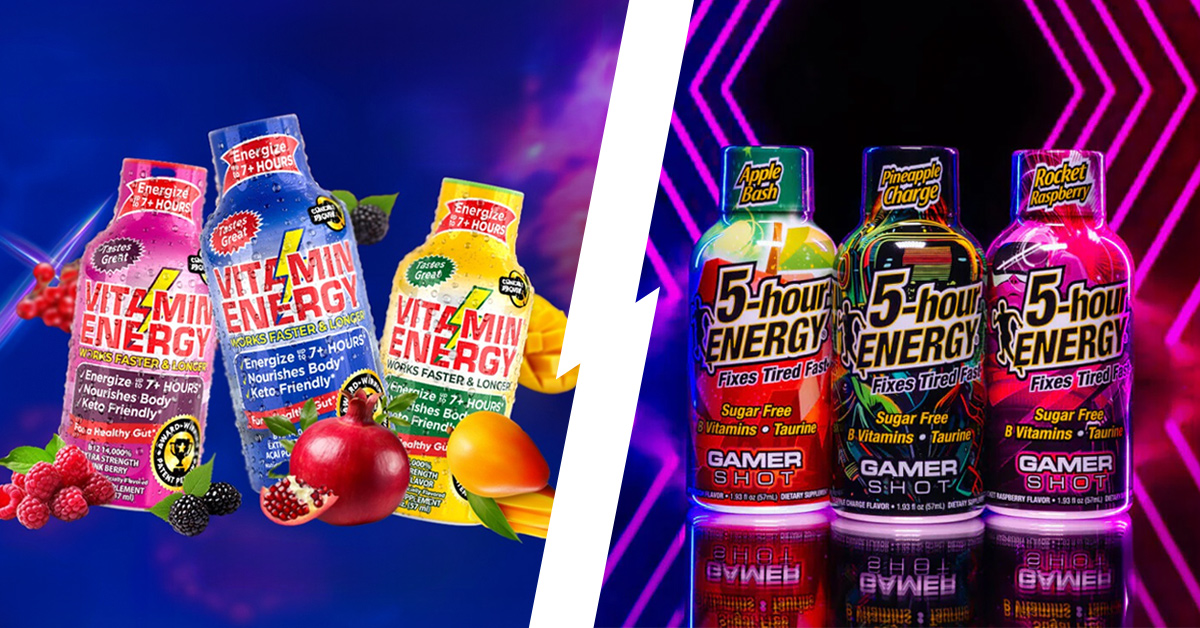
A federal court judge in Michigan last week dismissed a class action suit against 5-hour Energy alleging the company leveraged exclusive placement agreements with retailers to block competing energy shot brands and maintain a monopoly over the category.
The complaint, filed in November by rival Vitamin Energy, alleges that 5-hour Energy’s associated companies – Living Essentials, LLC, International IP Holdings, LLC and Innovation Ventures, LLC – violated U.S. antitrust and false advertising laws. It cites agreements 5-hour Energy has with convenience channel chains Pilot Flying J and Casey’s as examples of its anticompetitive behavior.
Vitamin Energy entered into a distribution agreement with Pilot in 2020, through which it secured prominent product placement with checkout counter display racks in over 500 stores. The company alleges that, after learning about this contract, 5-hour Energy “induced Pilot to swiftly remove the Vitamin Energy racks along with other Vitamin Energy product from the point-of-sale locations” and place them in “a secondary, more obscure location.”
The plaintiff claims its sales in Pilot were over $225,000 in 2020, but after the racks were removed in 2021, they plummeted by over 30%.
However, in his opinion, Judge Jonathan J.C. Grey said Vitamin Energy failed to prove its alleged lost sales were anything other than “the natural results of legal competition.”
“A 30% decrease in profit over a single year can hardly substantiate an antitrust injury without additional factual support. Additionally, Vitamin Energy’s other claims – that its products were relegated to less prominent placements or removed from Pilot stores – are the results of rigorous competition, not antitrust violations,” wrote Judge Grey.
Furthermore, the judge noted that simply losing a competitive placement within a store does not harm overall competition. Vitamin Energy has continued to make a “substantial profit” ($150,000) at Pilot even after allegedly losing its counter rack placement.
Vitamin Energy has also admitted its counter rack placement and rebate program with Pilot mirrored 5-hour Energy’s allegedly anticompetitive agreement with the chain and other c-stores, but did not make a distinction between the two agreements.
“The court will logically assume that a counter placement agreement is not out of the norm in the energy drink business. To the extent that Vitamin Energy alleges [5-hour Energy’s] agreements required some level of exclusivity, this argument is weakened by Vitamin Energy’s continued presence in Pilot stores,” wrote Judge Grey.
5-hour Energy has long held the top spot in the shelf-stable energy shot segment. Although its dollar sales have been on the decline as of late, 5-hour Energy still holds a dominant 84% share of the category, according to Circana data.
In the 52-week period ended June 15, 5-hour Energy’s dollar sales in the U.S. MULO and convenience channels dipped 7.2% year-over-year to $728 million, per Circana. Comparatively, Vitamin Energy’s retail sales were down 5.9% to just $716,530 in the same period. However, that data does not necessarily include all product lines or retail accounts for the companies.
This isn’t the first time 5-hour Energy has been accused of engaging in anticompetitive behavior. In May, a California federal judge found the company created an unfair competitive environment for family-owned wholesalers by offering “disproportionate promotions” to Costco, but did not violate antitrust laws.