

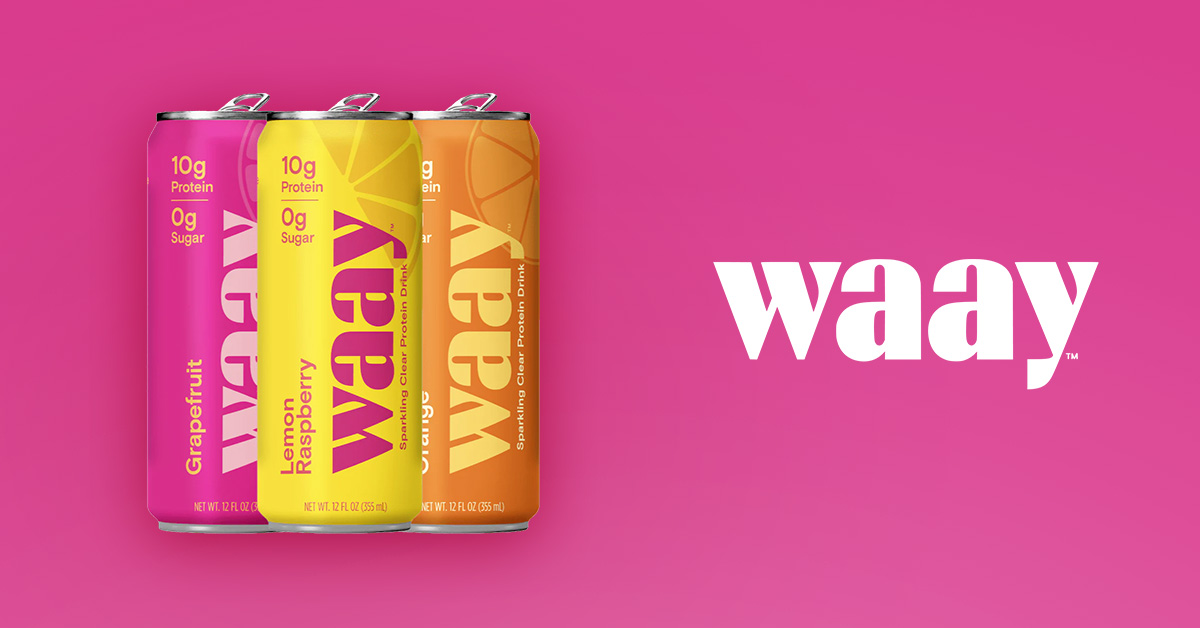
Primal Kitchen co-founder Morgan Zanotti returned with her second entrepreneurial endeavor this month: sparkling protein water brand Waay, now available at Whole Foods Market stores nationwide.
Unlike her first endeavor, which pioneered seed oil free condiments a decade before the concept had traction among consumers, Zanotti, said the sparkling protein water category is growing faster than anything she has seen “in the history of CPG.” She claims the idea, in development for the last 18 months, started with a common sense assessment of her own consumption habits.
“I don’t need protein in every single thing I’m eating, but I am drinking protein and that drinking protein experience is pretty gym bro, chalky, sticky, creamy, milky, heavy, overly processed,” Zanotti said. “I’m not a believer that we should be supplementing our entire diet, but I am [aware] that we’re drinking the drinks and it could be tasting better and doing more for us.”
The shelf-stable, whey-based beverage is launching in three flavors – Grapefruit, Lemon Raspberry and Orange – with each 12 oz. can contain 10 grams of protein and no sugar. The formulation also features collagen peptides, stevia and monk fruit. Waay has nationwide distribution with UNFI and will be onboarded with KeHE by the end of the year.
Waay’s debut is another notch in the growing “proteinification” of all consumable products, particularly the infiltration of the macronutrient into new beverage formats where protein is now moving beyond the powder and RTD shake set. The brand faces a field competition including protein soda from Don’t Quit, energy and protein water from Vuum, protein snacks from Genius Gourmet, clear protein drinks via RYSE and many more.
A Waay To Rewire Women’s Health?
For Zanotti – a 5 ft tall, 112 lb female “who’s been trying to lose the same five to 10 pounds for the greater part of the last two decades” she said – Waay is more than just another beverage for bulking up gym bros. Rather, it signals the start of a larger conversation around women’s health.
“I’m 41 and for the first time in my life, we’re telling women to eat more of something,” she said. “My whole life we have been telling women to eat less calories, eat less carbs, oh now we’re fat free.. then it was like, ‘actually, don’t eat at all’ – we’re intermittent fasting, but then protein came around.”
She believes an emphasis on increased protein intake helps counter the harmful, “food obsessed” mindset entrenched in diet culture, putting the focus on longevity, muscle retention and healthy aging rather than weight. Zanotti herself was told by a naturopathic doctor that she should consume protein every two hours, leading her to assess her eating and drinking habits, which can include upwards of four cans of La Croix per day.
“They taste like dirty socks and it would be great if one or two of them were doing more for me because let’s be real I have three kids under the age of seven, and I’m not eating three meals a day,” she said.
Zanotti’s observation also mirrors emerging category dynamics around protein beverages. According to Brightfield Group’s Q3 2025 analysis, the rise of protein beverages beyond the shake set has been driven by a product’s ability “to flex into daily routines, times of day, and even life stage needs, particularly for women.”
The report found that 31.7% of consumers are seeking high-protein drinks, with purchase growth up 11.2% year-over-year. Brightfield also tracked whitespace for protein water to fill with 87% of consumers who value high-protein claims reporting they also purchase water.
“I don’t think there’s really anything that revolutionary or life changing about [protein’s rise],” Zanotti noted. “It is an amalgamation of a lot of trends hitting at once. I think what also has been really evident to me is just how much faster the CPG industry is moving now than it ever did historically.”
‘The Power of Relationships’
Zanotti, whose early career brought her through kombucha brand Kevita ahead of its 2016 sale to PepsiCo, emphasized the beverage industry endeavor is moving a lot faster than her experience in food with Primal – which scaled to $50 million and sold to Kraft Heinz for $200 million in three and a half years.
Waay, she said, has earned significantly more distribution opportunities much earlier in its lifespan than Primal, momentum she attributes to awareness among major retailers that they should be building out their better-for-you sets. Zanotti plans to grow Waay first in the natural channel and then expand “pretty quickly” from there.
“You need some discipline [with retail partnerships] because you don’t want to go too early into the wrong retailer,” she said. “I believe in the power of relationships and going in when you have a partner I think is more important than where you go or when.”
The female-founded company counts Kate McAndrew of pre-seed venture firm Baukunst as its lead investor; Zanotti is currently in the process of closing the brand’s friends and family round, noting that “even my therapist wants to put money in.” Primal Kitch co-founder Mark Sisson has joined as an advisor along with an array of industry veterans and nutrition focused influencers.
As for the potential for Waay to build as a platform brand, Zanotti said she already has a handful of new flavor extensions ready to go when retail distribution and momentum behind the brand justify new launches. She is also toying with the idea of a higher-protein (20 gram) iteration of the product. In the near term, she is focused on building the brand in retail, with the help of some “shoppy shop” placements to help jumpstart brand awareness.
“There is nowhere harder [than the beverage industry], but also nowhere a brand has an opportunity to really explode as fast as they do [if they have the] TAM,” she said. “We are a very high consumption beverage society. It’s an accessory, a personality trait. [Beverage] is kind of an interesting intersection of culture, self-identity and business.”