

The First Drop: Searching for Signal
Remember the Long Tail?
What an exciting idea it was – a subculture smorgasbörd, offering the enticing possibility that we would all be able to get the products that satisfy our own specific niche.
The idea was largely driven by the growth of Amazon and other shopping networks, whose efficiency in search and delivery would allow consumers connections to the wide range of items that they might want. Think about products free of specific allergens, or containing the exact amount of a certain functional ingredient. Or t-shirts that suit the fan of only the Michael Keaton Batman movie character, and kick Robert Pattinson to the curb (or t-shirts that feature Robert Pattinson being kicked to the curb, or by the people on the curb, or by the curb itself. Come to think of it, there has to be a quantum universe that features only Robert Pattinson getting kicked).
The advent of social networking sites like Instagram and TikTok were initially believed to be hypercharging the Long Tail
– communities that might have sat in reddit or inward-facing chat groups were able to push outward, in highly searchable and, most important, highly shareable formats. Founders would be able to develop or share products that capitalized on those constituencies.
But something happened to the Long Tail on its way to that efficient redistribution of product to need: the means of communication became the product itself. Product makers large and small have bought into the idea that the ability to master and communicate the needs or beliefs of a specific community has become much more valuable than the needs or beliefs of the community itself. In other words, mastery of the medium is far more important than mastery of the content. Success is not
areaof knowledge: in fact, their best area of knowledge is influence itself.
That’s what changed the Long Tail. Instead of a distributed network of brands and consumers looking to satisfy their own needs on a bespoke basis, the influencer is able to create needs that consumers didn’t know they had – often because they don’t have that need.
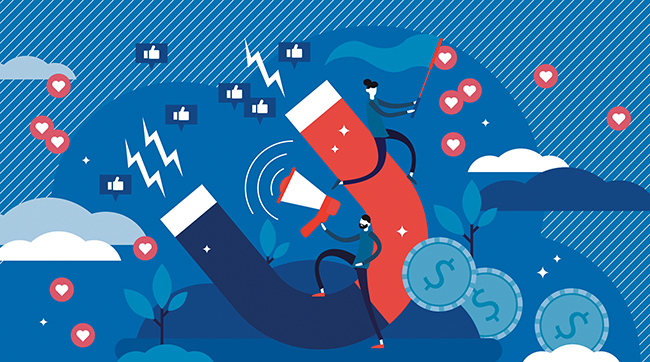
On a basic level, that’s the role of any kind of brand representative, but for a long time those reps were carefully curated for a particular product. At this point there’s such a level of oversaturation that the power of influence is sold, post by post, often without concern for consistency or credibility. It’s all about the tractor beam.
Now, it would be easy to get political here and talk about the fact that a power base has grown by helping cohere distrust into a wave that attacks and disqualifies the credibility of all institutions, furthering the concept of reach as the ultimate arbiter of truth, rather than truth allowing for the extension of reach. But this isn’t Mother Jones, it’s a beverage publication, and there’s a commercial endgame to be considered.
When I talk to investors, particularly early-stage backers, there’s a near-uniform caution around putting too high a valuation around a brand in that seed stage. That money creates expectation on return that is hard to fill. It’s clear that the reach of celebrity and influence is a kind of capital in itself, and that it’s also an expectation that isn’t easy to fill when it comes to consistently moving product.
What I’d ask you to consider is whether, by relying too much on influencers to create instant audiences around unproven products, we’re creating the same kind of sugar high that has doomed other emerging tech and consumer waves. I’d ask you to look at the broad swath of products that have relied on the kind of immediate attention that comes from influencer drip and think about whether the expense and early orders don’t just create a louder crash from a higher initial shelf.
If you can’t hear the splat, it’s because so many of them are doing it at once that it’s enough to blanket all of those small communities of the Long Tail in white noise. Surely, there’s a different signal out there.


Receive your free magazine!
Join thousands of other food and beverage professionals who utilize BevNET Magazine to stay up-to-date on current trends and news within the food and beverage world.
Receive your free copy of the magazine 6x per year in digital or print and utilize insights on consumer behavior, brand growth, category volume, and trend forecasting.
Subscribe