

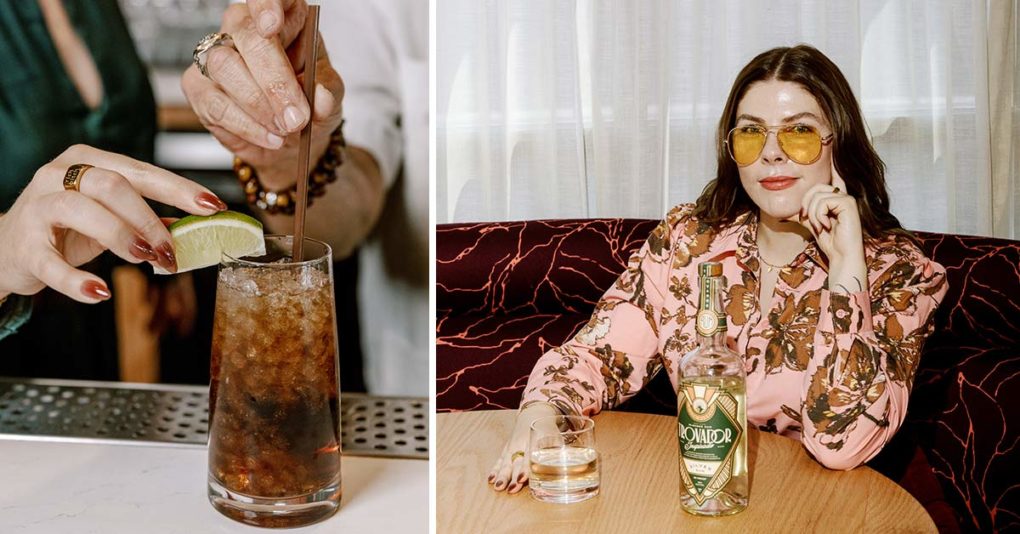
As a nomadic distiller, Devon Trevathan travels the world through her company, Liba Spirits, setting up shop in far-flung distilleries to work her magic with local ingredients, equipment, and artisans.
Her latest venture is a bit different: Trovador Inspirado Rum, a project she co-created with a team of Nashville hospitality pros and Raul Malo, frontman of The Mavericks, honors the traditions of Mexican, Cuban, and Spanish-Caribbean rums.
We chatted with Trevathan about why she’s hedging her bets on rum, what her checklist is for creating a new spirit, and how craft spirit makers can adapt to a changing spirits industry. Answers have been lightly edited for clarity and length.
Your latest project is a rum brand, why rum?
All roads lead you back to rum at some point – I think this is true for anyone who spends time in spirits and distilling. Thinking about the variety of flavor coming out of a series of islands that when put together would be smaller than the state of New Mexico, is astounding.
The knowledge in these places has been carefully maintained, passed down from generation to generation, and it shows in the spirits that are produced: the distinctiveness in character between countries, the mindboggling expanse of flavor compounds on display. Rum is awe-inspiring, it is a spirit worthy of respect and admiration, and I was overjoyed to get the opportunity to create this new blend.
What’s the white space Trovador is filling?
We wanted to bring three distinct styles – Cuban-style, Dominican, and Mexican rum – together in a blend that would be easy to drink, appealing to both aficionados and novices. I think emphasizing the Cuban connection was a great way in. Cuba was so influential in creating their own signature style and process, which then informed so many of our classic cocktails.
That character was the foundation for the blend, especially considering Raul’s involvement and his relationship to Cuba, where much of his family is from. An aged Dominican rum added even more richness, and the Mexican rum made from fresh sugarcane juice brought grassiness and generally lifted the entire blend. I think Trovador manages to feel fresh and familiar all at once.
How did you get the idea to be a nomadic distiller?
That idea sprouted from necessity with just a dash of madness! My business partner Colton Weinstein and I actually both had the idea independently, and when we finally talked to each other about it we realized we had to give it a try.
The basic concept isn’t new: there’s been other nomad producers in the beverage space who inspired us, like Mikkeller and Brew Dog. I’ve been a bit of a nomad my whole adult life – lived in Italy, then Taiwan, then North Carolina, Tennessee, New York. So the willingness was there, and we realized that distilling in different places would give us access to all these unique raw materials. We could distill a gin in Austria with Italian lemons and have it be part of the same portfolio as a rum we distilled in New Orleans from Louisiana molasses, or an infused pisco aperitif we made in Chile, and we would be the ones to distill it all! It’s a dream.
What are some of the unique challenges and opportunities of being a nomadic distiller?
It’s quite literally nothing but unique challenges and opportunities. Obviously figuring out how to transport spirit across various countries was not easy; thankfully the worst consequence has only been the occasional fee. It’s also challenging to operate with limited storage space. We have to be aware of all of our supplies and the room we take up. As a result I think we’ve become extremely resourceful, able to pivot with a quickness, a skill that’s proven useful over the last few years.
And of course, we have been able to experience new distilling techniques, work with fruits, grains, and herbs in different continents, and taste such a wide array of spirits. I couldn’t pay for an education like this. It really showed itself when time came to create Trovador; we’re so used to working quickly, chasing down challenges and tackling them, that we went from inception to having bottles on the shelf in about eight months. I don’t know many other brands that have been turned around in that kind of time.
When thinking about your next spirit or location, what’s the checklist you are taking yourself through to determine if you should launch something?
Colton and I tend to start with the spirit. We’re hoping to work with agave next, since Mexico has been a place where we’ve wanted to distill since before we started the company. So we’ll likely distill a tequila or mezcal, and knowing that, we’ve been brainstorming what we would do. Our natural inclination as producers is not to go to a destination and make exactly what the local industry does best.
The big item on the checklist is finding a distillery that will let us use their space. Everyone imagines we look for the tiny family farm fermenting in goat hide on top of a mountain, but we mostly look for medium-sized independent producers. At the end of the day we’re operating a business, and we need to make sure our production is scalable, so that informs our search. As much as I’d love to only make hyper small batch $200 amaro, we’ve been intentional about pricing our spirits so they’re accessible. The best part of travel keepsakes is sharing them with people you love after your trip.
The spirits industry has changed very quickly in just a few years, how are you adapting?
I am extremely proud to be an independent distiller and producer. There’s no board of directors telling us what to do, or shadowy venture capital backers, and certainly nothing from the “Big Guys.” It is a hard time to operate as an independent producer, and I think most consumers aren’t aware of just how many bottles on the shelves aren’t made independently or in small batches (despite what terms may be used on the label), so I take my role as an advocate for this side of the industry seriously.
Magic can happen when passionate producers and distillers have the freedom and resources to operate fairly, we just need to ensure that we give them the support they need to get there. It’s those stories that often act as the industry’s lifeblood, they’re essential.
If you could wave a magic wand what would you change about the industry?
I would probably drop the curtain on the way that some of these companies operate. It would be amazing to have words like craft, small-bath and family owned mean something again, but I don’t expect consumers to spend their free time vetting every bottle or tracking mergers and acquisitions within the industry to see what’s owned by who and who’s benefitting from what. They shouldn’t have to do that. I wish I could just snap my fingers and give us an industry with real transparency. Oh, and I would get rid of the damn tariffs.